

What Is a Rental Deposit in Turkey, and What Is It For?
Known in Turkish as depozito, a rental deposit is security provided by a tenant to help cover obligations under a lease. It may be used toward unpaid rent, damage for which the tenant is responsible or other valid amounts owed under the agreement. Any remaining balance is refundable when the tenancy ends.
A security deposit is not an advance rental payment. It does not replace monthly rent, and tenants should not assume they can use it to cover their final month’s payment. A deposit is not mandatory for every rental agreement: whether one is required depends on the arrangement between the landlord and tenant, although requesting a deposit is common in Turkey.
It is also important to distinguish a deposit from two other rental-related payments:
- Kapora (reservation payment): An amount that may be paid to reserve a property before the rental agreement is finalized. The refund conditions should be clarified in writing.
- Aidat (building maintenance fee): A regular charge for shared expenses such as cleaning, maintenance, security and communal facilities in an apartment building or residential complex.
What Does “Depozito” Mean?
The Turkish word depozito comes from the Italian deposito, ultimately related to the Latin depositum, meaning something placed in safekeeping. In rental agreements, it refers to security that is generally repayable once the tenant has fulfilled the relevant obligations.
How Much Is a Rental Deposit in Turkey?
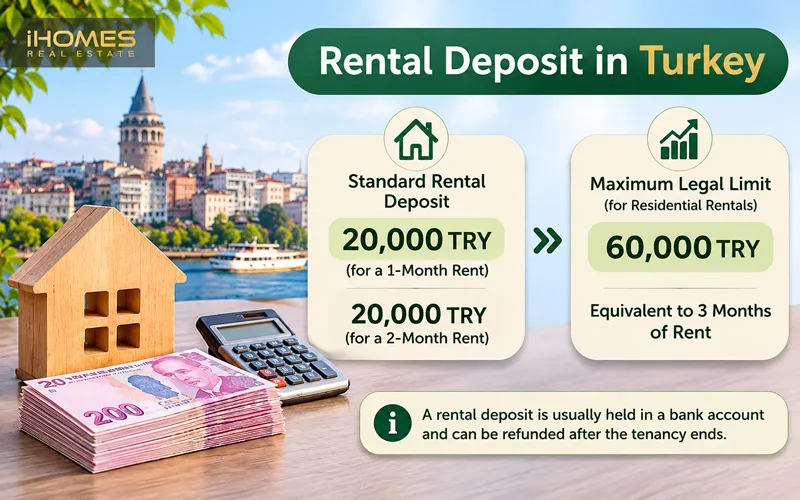
In practice, landlords often request a deposit equal to one or two months’ rent. The amount may vary depending on whether the property is furnished, the value of its contents and the agreed lease terms. For example, for an Istanbul apartment with a monthly rent of TRY 20,000, the deposit could be:
- One month’s rent: TRY 20,000
- Two months’ rent: TRY 40,000
- Three months’ rent: TRY 60,000
These are illustrations, not standard rates that every landlord is entitled or required to charge.
What Is the Legal Maximum Deposit?
Under Article 342 of the Turkish Code of Obligations (Türk Borçlar Kanunu), security provided under a residential or covered workplace lease may not exceed three months’ rent. For a property rented at TRY 20,000 per month, this means a maximum of TRY 60,000. That is a ceiling, not a minimum: the parties can agree to a smaller deposit or, if acceptable to both, no deposit at all.
Do Furnished and Unfurnished Properties Have Different Deposits?
Landlords may ask for more security on furnished properties because the tenancy also involves furniture, appliances and other items. An unfurnished apartment might be advertised with a one-month deposit, while a furnished property might require two months. These are market practices rather than separate legal rates for furnished and unfurnished homes.
Important: Even for a fully furnished or luxury apartment, the statutory ceiling still applies. Before moving in, prepare an inventory and a signed handover record describing the furniture and its condition. This can help prevent disagreements when you move out.
Rules for Paying and Holding a Rental Deposit in Turkey
Turkish law sets rules for how rental security should be handled. In particular, Article 342 provides a banking arrangement for cash deposits, designed to protect both the tenant and the landlord. Understanding this process before signing a lease can make recovering your deposit much easier.

Should You Pay the Landlord or Use a Bank Account?
Under Article 342, a cash security deposit is to be placed in a term savings account from which the funds cannot be withdrawn without the landlord’s consent. The bank may release the security in the circumstances specified by law, including agreement between the parties, a final court ruling or finalized enforcement proceedings.
If the landlord does not notify the bank within three months after the lease ends that legal proceedings or enforcement concerning the tenancy have been initiated, the bank must release the deposit at the tenant’s request. In everyday practice, some landlords ask to receive the money directly. However, this differs from the statutory bank-account procedure and can complicate a later refund dispute.
What Should You Check Before Paying a Deposit?
The safest approach is to document the amount, payment method and refund conditions before transferring any money.
Rental deposit checklist:
- Record the amount in the lease: Specify the exact deposit, currency and applicable refund conditions.
- Use a documented payment method: Follow the legal deposit-holding procedure where applicable, and retain all bank records.
- Ask for a receipt: If money is handed directly to a landlord, obtain a dated receipt stating the amount, recipient and that the payment is a security deposit.
- Check currency rules: Turkey restricts the use of foreign currencies in certain rental agreements, although exceptions may apply, including in some situations involving foreign tenants. Have the legal position checked before agreeing to a deposit denominated in US dollars or euros.
- Clarify refund and deductions: Put the return procedure and the treatment of any proven damage or outstanding bills in writing.
- Document the property condition: Take dated photos and videos of walls, flooring, fixtures and furniture, and prepare a handover report where possible.
Tip: Do not rely solely on verbal assurances from a landlord or agent. A clear lease, proof of payment and a move-in condition report are your strongest practical safeguards.
How to Get Your Rental Deposit Back in Turkey
To request a refund, the tenancy must have ended lawfully and the property must have been properly handed back to the landlord. This may follow expiry of the rental arrangement, a mutual agreement or a valid termination. Once outstanding rent, charges and any substantiated damage have been addressed, the tenant can seek repayment of the remaining deposit.
At move-out, inspect the property together if possible, document its condition, return all keys and sign a handover report. Any deduction from the deposit should have a clear and supportable basis.

When Must the Landlord Return the Deposit?
As a general rule, the deposit should be settled when the tenancy has ended, possession has been returned and the tenant’s outstanding obligations are known. However, Turkish law does not impose a universal refund period of seven or thirty days for every deposit arrangement. The lease terms and the way the deposit is held matter.
Understanding the three-month bank rule: Under Article 342, if the deposit is held in the legally prescribed bank account and the landlord has not notified the bank of relevant legal or enforcement proceedings within three months after the lease ends, the bank must release the money upon the tenant’s request. This does not mean every landlord automatically has a right to keep a deposit for three months. If the parties agree and there are no outstanding issues, repayment may take place sooner.
Which Documents Should You Keep When Moving Out?
- Rental agreement: Shows the agreed security and the parties’ obligations.
- Deposit receipt or bank record: Confirms the amount and currency paid.
- Property handover report (Teslim Tutanağı): Records the move-out date, property condition and keys returned.
- Move-in and move-out photos: Help establish whether any damage occurred during the tenancy.
- Proof of settled bills: Includes electricity, water, gas and any building maintenance charges (aidat) for which the tenant is responsible.
Keep written proof that the landlord received the keys. Simply leaving an apartment empty does not always establish that possession was legally returned. Also, avoid signing a document stating that all claims have been fully settled if your deposit is still outstanding and you have not agreed to waive it.
How Is the Deposit Calculated When You Move Out?
Tenants often ask whether they will receive the original sum after several years or whether the deposit can be recalculated to reflect increases in rent. There is no single answer for every lease. The result can depend on the contract, the payment and holding arrangements, and the approach taken by Turkish courts. In certain disputes, the Court of Cassation (Yargıtay) has considered the original deposit as a proportion of the monthly rent, but this should not be treated as an automatic rule for all deposits.
Can the Deposit Be Recalculated Using the Current Rent?
Some court decisions, particularly concerning deposits paid directly in cash, have applied a rent-ratio approach. Consider the following hypothetical example, where a tenant initially paid the equivalent of two months’ rent:
| Description | Amount |
|---|---|
| Monthly rent at the start of the lease | TRY 10,000 |
| Original deposit (two months’ rent) | TRY 20,000 |
| Monthly rent at move-out | TRY 30,000 |
| Illustrative value using the original rent ratio | TRY 60,000 |
If the specific lease and applicable case law support this method, the deposit could be valued at TRY 60,000 before any legitimate deductions. This is an example, not a guaranteed refund. An express contractual agreement about repayment of the nominal amount or the tenant’s waiver of additional claims may affect the outcome, subject to its legal validity. Deposits lawfully agreed and paid in a foreign currency may also be subject to different repayment considerations and Turkish foreign-exchange rules.
Does a Rental Deposit Earn Bank Interest?
Article 342 provides for cash security to be kept in a term savings account, so any interest accumulated in that account is relevant to the amount ultimately released. If the money was paid directly to the landlord instead, claims relating to interest or loss of value may become a legal dispute. Their outcome depends on the contractual terms and applicable law; no fixed rate of interest or increase can be promised in every case.
For this reason, make sure the deposit amount, currency, holding arrangements and repayment conditions are clear from the outset.
What Can a Landlord Deduct from a Rental Deposit?
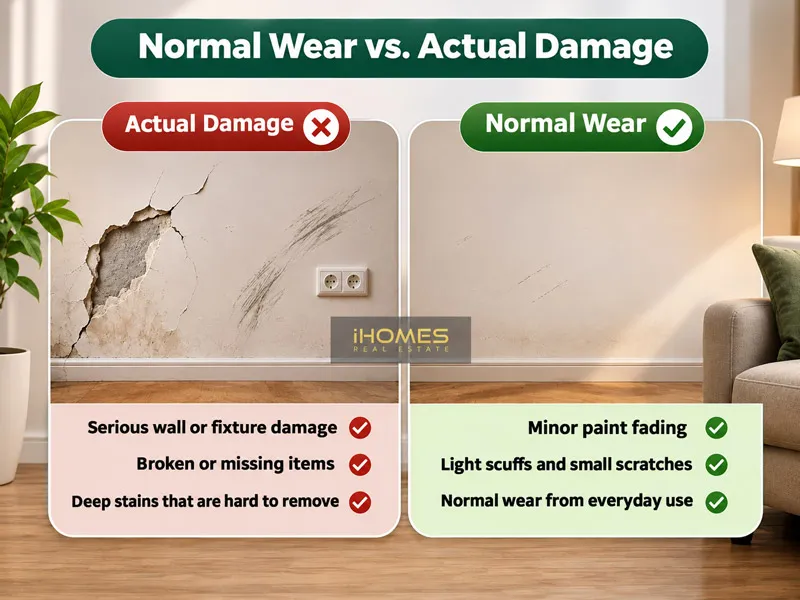
A landlord may seek to deduct proven amounts for which the tenant is legally responsible. However, not every visible change or sign of aging is chargeable damage. Under Articles 334 and 335 of the Turkish Code of Obligations, tenants are not responsible for deterioration arising from normal use, and landlords have duties to inspect the property and promptly notify tenants of identifiable defects upon its return.
What Is the Difference Between Damage and Normal Wear and Tear?
Normal wear and tear means the gradual changes expected from ordinary, reasonable use, such as slight fading of paint or natural aging of flooring. These generally do not justify a deduction. By contrast, broken glass, damaged cabinets or appliances harmed through improper use may be chargeable if the tenant is responsible and the loss can be substantiated.
Can Painting, Cleaning or Furniture Repairs Be Deducted?
That depends on the property’s condition at the start and end of the tenancy, the cause of the issue, the lease terms and the available evidence.
| Expense or issue | Can it be deducted? | Explanation |
|---|---|---|
| Natural fading of wall paint | Generally no | Usually ordinary wear over time |
| Severe stains or unusual wall damage | Potentially, if proven | Only reasonable costs attributable to the damage |
| Repainting the entire apartment | Depends on the circumstances | Moving out alone does not justify a full repainting charge |
| Exceptional cleaning due to serious dirt or neglect | Potentially, if proven | Costs should be reasonable and supported by the handover condition |
| Normal aging of furniture and appliances | Generally no | Ordinary deterioration is not normally the tenant’s responsibility |
| Broken furniture or damaged appliances | If attributable to the tenant | Original condition, cause, age and evidence all matter |
| Unpaid utility bills or building charges | If legally owed by the tenant | The debt and responsibility for it should be demonstrable |
Important: Under Article 335, a landlord should inspect the property when it is returned and promptly inform the tenant in writing of defects that can be identified through an ordinary inspection. Failure to do so may result in the loss of the right to claim for those defects. If a hidden defect becomes apparent later, the landlord must also notify the tenant promptly after discovering it. Recording any disputed issues in the handover report can help both parties.
What Happens to the Deposit If You End Your Lease Early?
Leaving before the agreed end of a lease does not automatically mean losing the entire deposit. Early departure can, however, leave the tenant liable for certain amounts that may be relevant to the final settlement.
Under Article 325 of the Turkish Code of Obligations, a tenant who returns a property before the contractual or legally applicable end of the tenancy may remain liable for rent for a reasonable period during which the property could be re-let on similar terms.
Do You Lose Your Deposit for Moving Out Before the Lease Ends?
No. A landlord cannot simply treat the whole deposit as an automatic penalty solely because the tenant leaves early. For example, someone who moves out four months before the agreed end date is not necessarily liable for all four months. The reasonable period needed to find a replacement tenant and the specific facts of the case matter.
If the departing tenant identifies a financially suitable replacement willing to take over the lease on similar terms, whom the landlord could reasonably be expected to accept, this may bring the tenant’s remaining liability to an end under Article 325.
Best practice: Before moving out early, obtain a written agreement covering the handover date, any remaining payments and how the deposit will be refunded.
What If the Landlord Refuses to Return Your Deposit?
If the landlord refuses to return a deposit without a valid reason after the tenancy and handover have been completed, the tenant may be able to pursue a legal claim. First, ask why the deposit is being withheld. Sometimes a disagreement can be resolved by providing payment records, a handover report or evidence about disputed damage.
Steps to Recover an Unreturned Deposit in Turkey
- Request repayment in writing: Send a clear message or formal request stating the deposit amount and asking when it will be returned. Keep copies of the correspondence.
- Consider a formal notice: If necessary, a Turkish notary (Noter) can be used to send a formal notice or demand (İhtarname).
- Apply for mediation where required: Since 1 September 2023, mediation (Arabuluculuk) has been a mandatory preliminary step for many rental disputes, including many deposit-related claims, before filing a lawsuit.
- Seek a legal remedy: If mediation does not resolve the matter, the tenant may be able to pursue recovery through the appropriate legal proceedings.
Useful evidence includes the signed lease, proof of deposit payment, records of moving out and returning the keys, condition reports and communications with the landlord.
Note: If the security is held in the statutory bank account, the release mechanism under Article 342 also needs to be considered. For large sums or complex disputes, seek advice from a lawyer experienced in Turkish tenancy law.
Practical Deposit Tips for Foreign Tenants in Turkey
If you are moving to Turkey from abroad or renting a property while living overseas, clear documentation is particularly important. Rental arrangements may involve unfamiliar legal terminology, different banking procedures and communication across languages.
- Understand the Turkish lease before signing: Check the deposit amount, currency, grounds for deductions and refund procedure. If you are not fluent in Turkish, obtain a reliable translation or help from a qualified professional.
- Create a detailed move-in record: Photograph walls, floors, fixtures and appliances. For furnished properties, record an inventory with the condition of each item.
- Keep your payment records: Save bank confirmations, receipts and other evidence until the deposit is fully settled.
- Confirm agreements in writing: Put any changes to the handover arrangements, deductions or refund timing in a document or traceable written exchange.
- Plan ahead if you are leaving Turkey: Agree on the refund method, bank details and expected settlement process before departing. If a dispute may need to be handled remotely, ask a lawyer whether appointing an authorized representative would be appropriate.
Remember: A rental deposit is intended as refundable security, not a non-refundable entry fee. Proper records and a clear handover process are the best ways to reduce the risk of disputes.
Frequently Asked Questions About Rental Deposits in Turkey
Can I Use My Deposit to Pay the Last Month’s Rent?
Not without the landlord’s agreement. The deposit and rent serve different purposes. If both parties agree to offset the deposit against the final rental payment, record that arrangement in writing.
Who Returns the Deposit If the Landlord Sells the Property?
Under Article 310 of the Turkish Code of Obligations, the new owner generally steps into the previous owner’s position under the existing lease. However, responsibility for a deposit paid to the former owner may depend on whether that deposit was transferred and the facts of the case. Document the deposit’s status in writing whenever ownership changes.
Do I Have to Pay Another Deposit When Renewing My Lease?
Renewing a rental agreement does not automatically require a second deposit. The existing security generally remains in place until the tenancy ends, unless there is a legally valid agreement changing its terms.
Can the Landlord Increase the Deposit When the Rent Goes Up?
A rent increase does not automatically increase the security deposit. Any request for additional security must be considered under the applicable tenancy protections, the terms of the agreement and the statutory cap.
Can I Recover a Deposit Without a Written Lease?
Potentially, yes. A missing written lease does not necessarily prevent a tenant from proving the tenancy and deposit payment through bank records, messages, receipts and other admissible evidence.
Are the Deposit Rules Different for Foreign Citizens?
The core tenancy-security rules generally apply to foreign tenants as well as Turkish citizens. However, foreign-currency restrictions and practical banking requirements may vary according to the parties’ circumstances, nationality or residence status. It is worth checking these details before signing.
What If the Landlord Refuses to Accept the Keys?
Seek legal guidance about formally documenting an offer to return possession and using the appropriate notarial or court procedure if necessary. Simply vacating the property or leaving the keys with an estate agent may not end the tenant’s rental obligations.
What If the Damage Exceeds the Deposit?
Where the landlord can substantiate legally recoverable losses greater than the deposit, the landlord may seek the difference from the tenant. Ordinary wear and tear should not be included as compensable damage.
Summary: What to Know About Deposits in Turkey
A rental deposit is a common form of security when renting a home in Turkey, with a statutory ceiling of three months’ rent for residential leases. To avoid problems later, agree on the amount, currency, payment method and refund arrangements before moving in. Keep proof of payment, document the property’s original condition and obtain written confirmation when you hand it back.
If you are planning to rent an apartment or house in Istanbul, the iHOMES real estate team can help you explore suitable properties and understand common rental expenses, including deposits and building maintenance charges.
Contact iHOMES for a free consultation about renting property in Istanbul.
WhatsApp: +90 552 630 60 00